
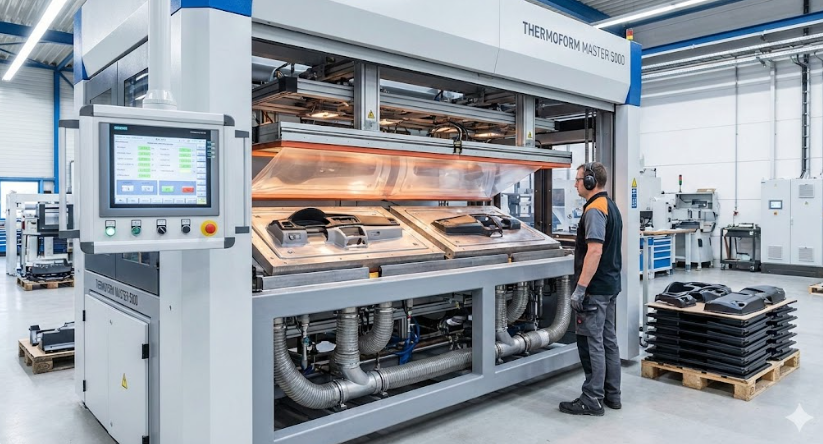
Thermoforming Vacuum Machinery: Revolutionizing Modern Industrial Manufacturing
In the rapidly evolving landscape of industrial production, thermoforming vacuum machinery stands as a cornerstone technology for plastic fabrication. This process, which involves heating a plastic sheet until it becomes pliable and then using a vacuum to pull it over a mold, has become essential for creating everything from simple food containers to complex automotive components. As global demand for high-quality, lightweight products grows, understanding the nuances of vacuum forming technology is vital for any competitive manufacturer.
How Thermoforming Vacuum Machinery Works
The core principle behind thermoforming vacuum equipment is the manipulation of atmospheric pressure. The process is elegant yet highly technical, requiring precision at every stage. First, a thermoplastic sheet is clamped and heated in an oven until it reaches its optimal forming temperature. Once the material is soft enough, it is moved over a mold.
At this critical moment, the high-performance vacuum pump removes the air trapped between the plastic sheet and the mold. The resulting pressure differential forces the plastic to take the exact shape of the mold with incredible detail. After the material has cooled and solidified, the part is ejected and trimmed to its final dimensions. This automated forming cycle ensures consistency and speed in high-volume production environments.

Key Components of a Vacuum Forming Machine
Modern industrial thermoformers are equipped with several high-tech components that ensure efficiency:
- Ceramic or Quartz Heaters: For precise and even heat distribution across the sheet.
- PLC Control Systems: Digital interfaces that allow operators to manage production parameters in real-time.
- Pneumatic or Hydraulic Press: Used for heavy-duty applications requiring more than just vacuum pressure.
Major Applications of Vacuum Forming Technology
The versatility of thermoforming vacuum machinery allows it to serve a diverse range of industries. Because the tooling costs are significantly lower than injection molding, it is the preferred choice for many businesses.
- Packaging Industry: Most of the trays, clamshells, and blisters used in food and retail are produced via high-speed thermoforming.
- Automotive Sector: Large parts like door liners, dashboards, and exterior panels are made using durable, impact-resistant plastics.
- Medical Equipment: The ability to use specialized, sterile materials makes this machinery ideal for medical tray manufacturing and device housings.
- Aerospace and Transit: Interior seating components and ceiling panels in airplanes and trains are often vacuum formed for weight reduction.
Advantages of Using Thermoforming Vacuum Machinery
Why should a business invest in advanced vacuum forming solutions? The benefits extend beyond simple production:
1. Cost-Effectiveness
One of the primary drivers for choosing this technology is low tooling costs. Molds can be made from aluminum, wood, or even 3D-printed resins, making prototyping and short-run production much more affordable than other methods.
2. Rapid Prototyping
Because the molds are easier to manufacture, the “time-to-market” is significantly reduced. Businesses can test designs and make adjustments quickly, which is a major advantage in the fast-paced plastic manufacturing industry.
3. Design Flexibility
Whether you are producing small electronic enclosures or large-scale signage, custom vacuum forming offers the flexibility to work with various textures, colors, and thicknesses of plastic sheets.
Choosing the Right Thermoforming Machine
When looking for thermoforming machinery for sale, it is important to consider the “draw depth,” the sheet size capacity, and energy efficiency. A fully automatic vacuum former might be a larger initial investment, but the reduction in labor costs and the increase in output usually provide a swift return on investment (ROI).
In conclusion, thermoforming vacuum machinery continues to be a driving force in manufacturing innovation. By combining precision engineering with cost-efficient processes, it provides a reliable pathway for businesses to create high-quality plastic products for the global market.
Author’s Note: Staying updated with the latest trends in sustainable thermoforming and recycled materials is key to future-proofing your production line.
Size özel teklif veya ücretsiz ön görüşme için hemen iletişime geçin.

Bir yanıt yazın